
April 2026 Updates
Once more unto the breach


It is a bit tricky to balance writing new posts and updating old ones. As this library of societal collapse research grows, there is an ever larger backlog of posts that would like to see some updates. Even though the update posts usually have a readership equal or even slightly higher than the other ones here, I do think that having regular completely new posts is important to keep things interesting. So, I will continue to try to find a balance here, but if any of my readers have a strong preference here, I’d be curious to hear it. Also, I recently was on a podcast, where I summarized many insights from this blog here. Check it out, if you would like to see a bit more conversational version of this living literature review. But now, the actual updates.
What could go wrong?
This post is meant to give an overview of what all kinds of academic and political institutions think constitutes a global risk. Basically, it is a collection of collections of catastrophes. To this collection I have added two new reports. The first one is by the UK Ministry of Defence, (2024).
Such kinds of catastrophes are also highly relevant to defense. Therefore, defense ministries also try to map out the different risks their countries might face in the future. An example of this would be a report by the UK Ministry of Defence (2024). They tried to map out what the strategic trends will be until 2055. A strategic trend is not the same thing as a catastrophe, but still the main drivers of trends they identify look eerily familiar to the kinds of events we have covered in this post so far. More specifically, they identify six main drivers of global change:
Global power competition
Demographic pressure
Climate change and pressure on the environment in general
Technological advances and connectivity
Economic transformation and energy transition
Inequality and pressure on governance
They assess that we are in for a wild ride, because many of these trends push the world in different directions. For example, economic transformation and technology will connect the world at an increasing rate, while global power competition will lead to fragmentation. Or similarly, that more and more people globally feel empowered to speak up and mobilize, while at the same time autocratic governments seem to be on the rise.
The risks and trends are also assessed on their impact and uncertainty. Here AI comes out on top for causing the most uncertainty, while global power competition is assigned the position of the most impactful one for the state of the world. As they assess global power competition as the most impactful one, much of the rest of the report is trying to map this out in more detail. They think that the United States will remain the most powerful nation, but will face increasing competition from China, Russia’s future depends on the outcome of the war in Ukraine, India will play a major role, but struggle with internal unrest and many of the middle power will band together, to have a chance in a world of weakening international agreements.
A second report I have added is by Graham et al. (2025), which translates the methodology of the Swiss national risk assessment to Australia:
What has been encouraging here is that good national risk assessments can work as an inspiration for other actors. For example, in a recent report by Graham et al. (2025), a group of researchers used the methodology of the Swiss national risk assessment and transferred it to Australia and showing that even under traditional risk assessment (accounting for both likelihood and magnitude of the consequences), the annual expected impacts of some global catastrophes are far higher than many of the more frequent threats (like floods or fires) and thus Australia should invest more to prevent damages from global catastrophes.
End time economics
What are the economic consequences of global catastrophes? This is generally quite hard to assess, as we are often lacking the data to even calibrate our models on. However, there is still some historical data that can be used. One paper that has accumulated such a dataset is by Blouin et al. (2024):
A paper that looks more systematically into the impacts of industrial destruction is by Blouin et al. (2024) (Disclaimer: I am a co-author on this one). The general idea is that, while we cannot easily assess the damages a nuclear war might do to industrial output, we can look into history, to find case studies of how destruction of industry leads to declines in industrial outputs and extrapolate from this. These case studies reach from major hurricanes to the Second World War (Figure 1).
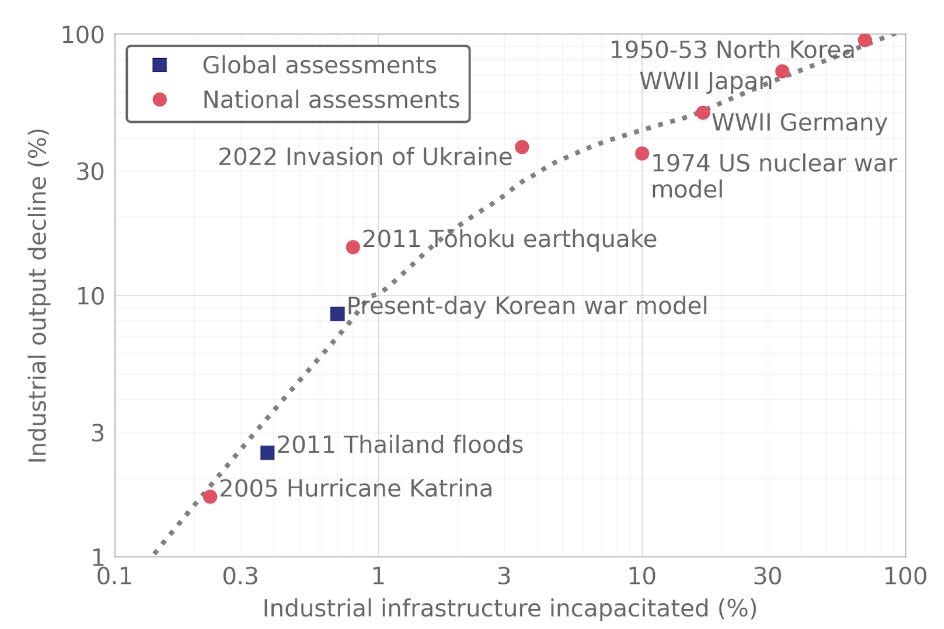
Figure 1: Relationship of incapacitated industrial infrastructure and subsequent decline in industrial output. Based on historical case studies and modelling studies.
In addition to establishing this relationship between industrial destruction and declines in output, the study also assesses how much of industrial capacity would be destroyed in US/Russia and India/Pakistan conflicts. This can be estimated from plausible target lists and the destruction caused by the nuclear weapons detonating above those targets. In the case of the US/Russia conflict the estimate is that this could destroy roughly 3 % of global industrial capacity, which would translate to a 24 % loss in global industrial output from the detonation damage alone. This strongly nonlinear relationship between destroyed capacity and declining output highlights the vulnerability of economies to large scale disruptions.
Systemic risk and the polycrisis
The ongoing polycrisis and systemic risk in general are hard to pin down. This is not also true in general, but even more so the case when it comes to policy making. Still, there are some attempts to think about how even such complex topics might be governed. One of those attempts is by Studzinski et al. (2025):
Coordinating around such complex problems is quite difficult. Where even to start? One thing that is clear, that global coordination is needed one way or the other. An attempt to get this started was the United Nations’ Summit of the Future. The summit was meant to start the reform of the United Nations 75 years after their founding and resulted in the Pact for the Future, which spelled out 56 goals which should guide the way to tackle the existing global challenges. How well this worked out and what we might do better in the future is discussed in Studzinski et al. (2025). They start with the criticism that the Summit of the Future did have a too narrow view on individual hazards and not really the bigger picture that would be needed to address the challenges we face. But the world as it is, is faced by threats that are larger than the sum of their parts. They are interconnected and reinforce each other.
The inability of global governance to effectively address the current global problems is caused by a variety of factors. One of them is that the situation is just tricky in general, and so it is to be expected that it cannot be solved easily and quickly. But also many of the existing institutions for global governance have ambiguous aims and missions, are often working against each other or are trying to find the least disruptive policy, in an attempt to please everyone. All in a world where international agreements are taken less seriously and the funding for global governance is decreasing.
But this does not mean that such summits are a waste of time. Ultimately, events like this are one of the few avenues of global governance that currently exist. Future summits need to get rid of their single hazard focus and instead focus on the interconnected problems we actually face. In addition to that, regional organisations like the European Union or the Shanghai Cooperation Organization could step up their game and implement measures to tackle systemic risks in their own borders, to showcase how this might also work on a global level. None of this is easy and likely needs a paradigm shift on how systemic problems are viewed, but getting this right is essential for the coming decades.
Economic inequality and societal collapse
One big factor that has come up in many of the papers I have been reading for this blog is inequality. It is just generally corrosive to societies if it gets too high. A recent paper by Alfani et al. (2025) does a comparative analysis of inequality in the Han, Roman and Aztec Empires:
Another large comparison of how inequality plays out in comparable polities is by Alfani et al. (2025). They created a dataset to compare inequality in the Han Empire and the Roman Empire. In addition, they compared both to a previous dataset from the Aztec Empire. Thankfully, for us the Roman and Han Empire were quite good at record keeping. While comparable on many axes, the Roman Empire tended to be less centralized and more self rule in the provinces.
Alfani and colleagues calculated the wealth of the different regions by the rate of their urbanization and population density, based on the assumption that more and larger cities and a higher population meant a province was richer. This showed that for the Han Empire the central province was quite rich, while the other provinces were much less so. In comparison, the Roman Empire had also a very rich central region, but also several other regions (e.g. in North Africa) which had considerable wealth. This is likely shaped by how both states used their military and bureaucracy. The military is usually deployed in frontier regions, meaning that wealth gets transferred there from the center, while the bureaucracy tends to accumulate in the central region, syphoning away wealth from other regions. The Han Empire had small military and large bureaucracy, while it was the other way around for the Romans.
In addition, to this inequality between regions, the paper also calculates the inequality in the population in general. They do so by tracking the size of the different groups of people in the empires (like peasants, aristocrats, merchants, etc.). This allows them to calculate a Gini index for the Han, Aztec and Roman Empire and compare it to the present day United States (Figure 1).
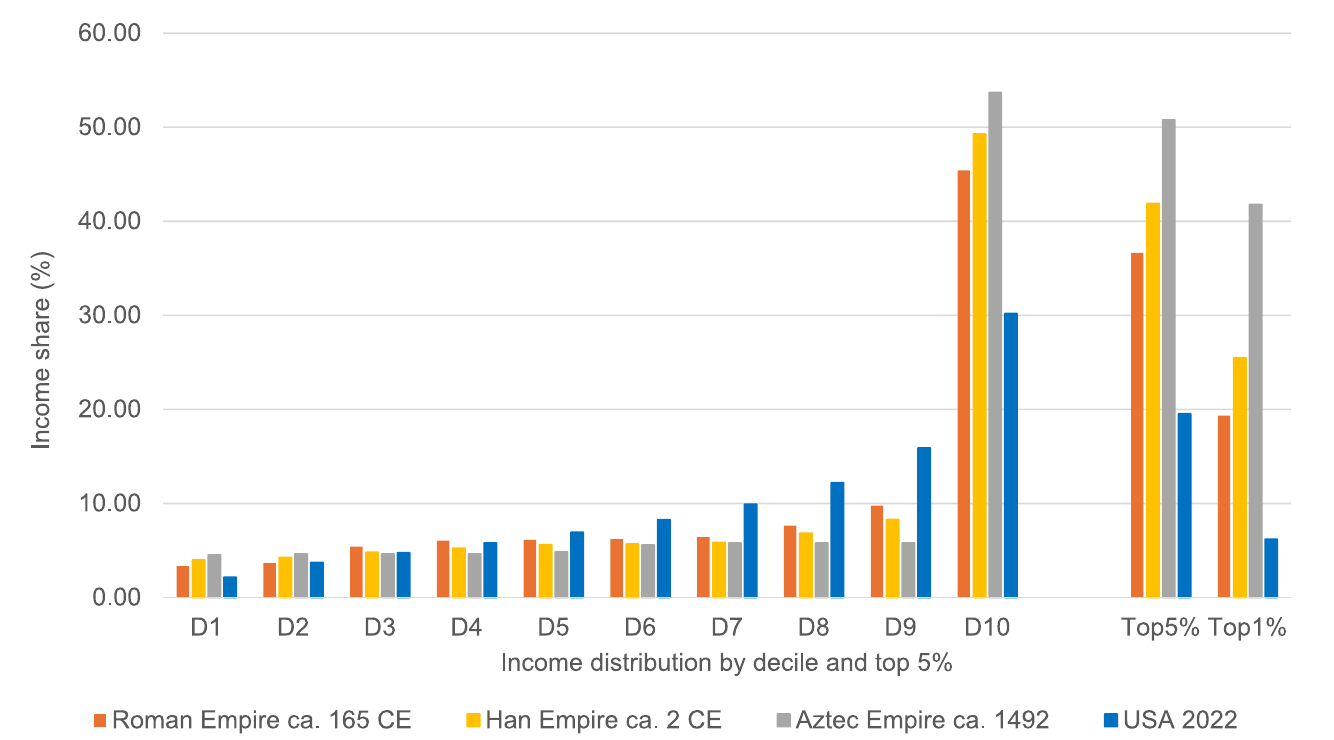
Figure 1: Comparison of income shares in the Roman, Han and Aztec Empire and the United States.
This highlights stark differences between the different empires, with the Aztec Empire being the most unequal one by far, followed by the Han and then the Roman Empire. The United States has not yet reached the levels of inequality of those past empires. However, what is notable, that relatively speaking the poorest 10 % in the United States are poorer than their counterparts in all the three other empires.
These differences in inequality are also mirrored in differences in stability. From those empires considered, the one with the highest inequality (the Aztecs) was the most unstable one, while the one with the lowest inequality (the Romans) was most stable. Obviously, these are only three data points and thus not super reliable, but it fits in with the general trend of the instability-inducing power of inequality.
Trade collapse
This post is about the importance of trade for the modern world and what might happen if it gets disrupted. I added a short paragraph to discuss a paper that looks into the importance of ports:
In addition to these chokepoints in general, we can also see that ports in general differ a lot in their importance for global trade. A paper by Verschuur et al. (2022) analyzed the world’s 1300 most important ports for global supply chains. Based on a large supply chain database, they tracked how many goods flow through all these ports. They find that in value terms, around 50 % of global trade flows through ports. Also, the ports differ wildly in their importance with some major ports like Antwerp, Los Angeles or Singapore having a highly important role in global trade flows (Figure 2). This means if any of those ports would be disrupted, it would likely have wide reaching ripple effects.
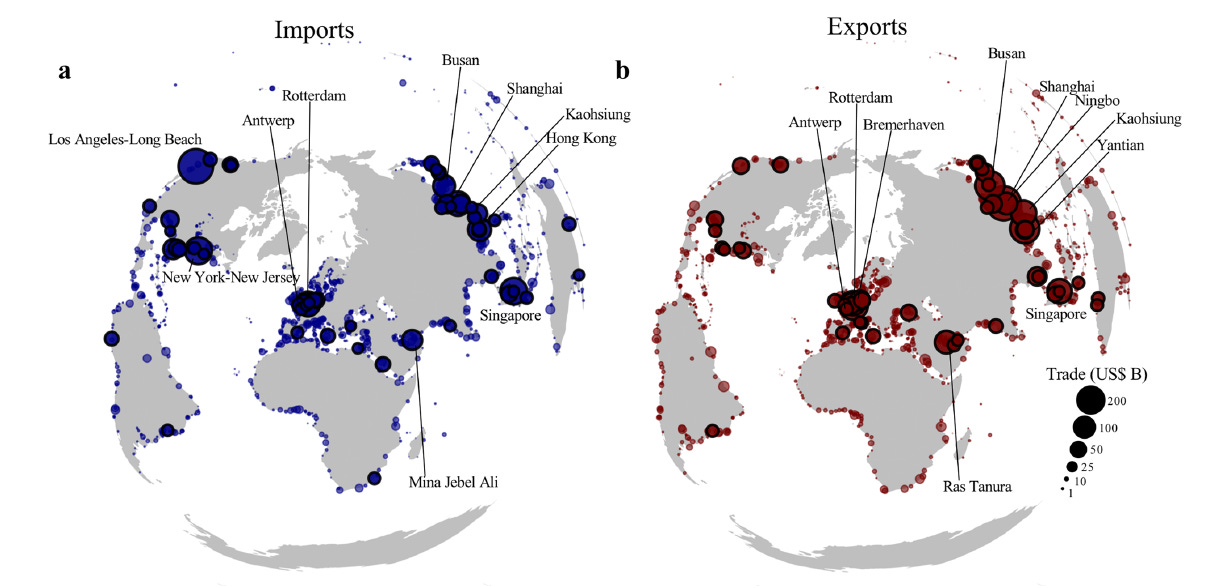
Figure 2: Globally important ports for imports and exports.
Share your favorite
Thank you for your interest in this academic experiment. Here’s a great song as an appreciation.
If this post (or others here) got you thinking, consider leaving a like. It helps more people stumble onto this blog.
As you made it this deep, I assume that you like the stuff that is written here. If you want to do me a little favor, I would really appreciate it if you could share your favorite post with someone who might enjoy it.
Go ahead, you can do it right now. Nothing more to read in this post anyway.
Much appreciated!
Until next time
Thanks for reading! If you want to talk about this post or societal collapse in general, I’d be happy to have a chat. Just send me an email to existential_crunch at posteo.de and we can schedule something.
References
Alfani, G., Bolla, M., & Scheidel, W. (2025). A comparison of income inequality in the Roman and Chinese Han empires. Nature Communications, 16(1), 3248. https://doi.org/10.1038/s41467-025-58581-0
Blouin, S., Jehn, F. U., & Denkenberger, D. (2024). Global industrial disruption following nuclear war. EarthArXiv. https://doi.org/https://doi.org/10.31223/X58H9G
Graham, J., Boyd, M., Sadler, G., & Noetel, M. (2025). Mapping Australia’s Risk Landscape: A Comparative Analysis of Global Catastrophic Risks and Traditional Hazards (SSRN Scholarly Paper No. 5253625). Social Science Research Network. https://doi.org/10.2139/ssrn.5253625
Studzinski, N. G., Kent, R., & Korowicz, D. (2025). Towards the Governance of Global Systemic Risk: Reforming the Summit of the Future. Global Governance: A Review of Multilateralism and International Organizations, 31(2), 113–136. https://doi.org/10.1163/19426720-03102002
UK Ministry of Defence. (2024). Global Strategic Trends: Out to 2055.
Verschuur, J., Koks, E. E., & Hall, J. W. (2022). Ports’ criticality in international trade and global supply-chains. Nature Communications, 13(1), 4351. https://doi.org/10.1038/s41467-022-32070-0
I enjoyed the podcast Florian! Nice free flowing conversation... Perfect workout listen.